Governed Agentic Automation for Chargebacks: A Prompt-First Architecture for Policy-Driven Enterprise Workflows
Abstract
Generative AI adoption is outpacing reliable productionization, especially in enterprise workflows that combine structured inputs, policy constraints, and operational risk. This technical report describes a prompt-first architecture for chargeback automation that replaces brittle, retrieval-heavy integrations with a governed orchestration layer for prompt management, policy enforcement, and observability. Using chargeback dispute handling as a case study, the report examines the transition from a Retrieval-Augmented Generation (RAG) design to modular prompt chaining and agentic execution over structured inputs. In internal deployment measurements, the prompt-first approach reduced generation latency by 35%, improved internal quality scores by 20%, and enabled near-immediate policy updates without re-indexing. A centralized guardrail framework auto-resolved 85% of policy issues before human review, while inter-rater agreement between reviewers improved from Cohen's kappa 0.65 to 0.82 across three optimization cycles. The results suggest that for decision-grade automation over structured enterprise data, governed prompt orchestration can outperform more complex retrieval-heavy designs in speed, controllability, and operational fitness. Some system names and implementation details are generalized.
Keywords: Generative AI, Agentic AI, Prompt Engineering, AI Governance, Chargebacks, Enterprise AI, LLM Orchestration, Risk Operations
Author note: This report reflects production lessons from enterprise AI automation. Some system names and implementation details are generalized for confidentiality. Quantitative performance figures reported here are internal deployment metrics unless otherwise noted.
1. Introduction
The current enterprise AI market is experiencing what many teams describe as an implementation hangover: adoption is high, but durable production value remains uneven. Gartner has projected that at least 30% of generative AI projects will be abandoned after proof of concept by the end of 2025 because of poor data quality, inadequate risk controls, escalating costs, or unclear business value [1]. MIT Project NANDA's GenAI Divide report similarly highlights a substantial gap between experimentation and measurable financial impact in enterprise deployments [2].
This report argues that the main bottleneck is often not model capability but system design. Many organizations still rely on point solutions: narrowly scoped, hard-coded wrappers around a model API that may work in isolated demos but degrade quickly under operational load, compliance review, or policy change. In contrast, production-grade workflows require governed orchestration: reusable infrastructure for prompt management, policy enforcement, evaluation, and observability.
To ground the discussion in a high-value, operationally demanding workflow, this report uses chargeback automation as a case study. Chargebacks and consumer disputes continue to impose significant costs on digital commerce. Sift, citing Mastercard data, reports worldwide chargeback losses of $33.79 billion in 2025, projected to rise to $41.69 billion by 2028 [3]. LexisNexis Risk Solutions reports that merchants spend an average of $4.60 for every $1 lost to fraud, underscoring the heavy operational burden surrounding fraud, disputes, and review processes [4].
Within this context, the objective was not simply to generate text faster. The goal was to make dispute handling operable at scale: measurable, auditable, policy-aware, and adaptable. The result was a prompt-first, agentic orchestration pattern that reduced resolution time from days to minutes in internal deployment while preserving control, traceability, and governance.
2. From Complexity to Clarity
Chargeback handling is a representative enterprise workflow because it combines structured evidence, evolving rules, and high review sensitivity. Engineering teams working in this class of problem face a foundational choice: increase system complexity in search of richer context, or simplify the architecture around the structure that already exists in the data and process.
Our design principle was to prioritize clarity, control, and adaptability over architectural novelty. That meant treating the workflow as a governed decision-support system rather than as a generalized question-answering problem. The practical implication was that the system had to support prompt versioning, policy updates, human review, and auditability as first-class requirements rather than afterthoughts.
A core lesson emerged early: architectural complexity can become its own source of latency, brittleness, and quality drift. In policy-heavy enterprise settings, the simplest architecture that preserves control often has the greatest chance of surviving production.
3. The RAG Roadblock: When Architecture Becomes Drag
The initial design followed a Retrieval-Augmented Generation (RAG) pattern. In theory, retrieval should improve factual grounding by embedding case materials, retrieving similar examples, and supplying them to the model as additional context. In practice, the workflow introduced multiple operational burdens that outweighed its benefits for this use case.
First, the RAG stack added too many moving parts. Vector stores, embedding pipelines, retrievers, and ranking layers all required maintenance and tuning. Second, retrieval frequently introduced context drift: redundant or weakly relevant examples contaminated the prompt and made outputs less consistent. Third, every policy or schema adjustment created re-indexing work, slowing iteration precisely when fast operational adaptation was most important.
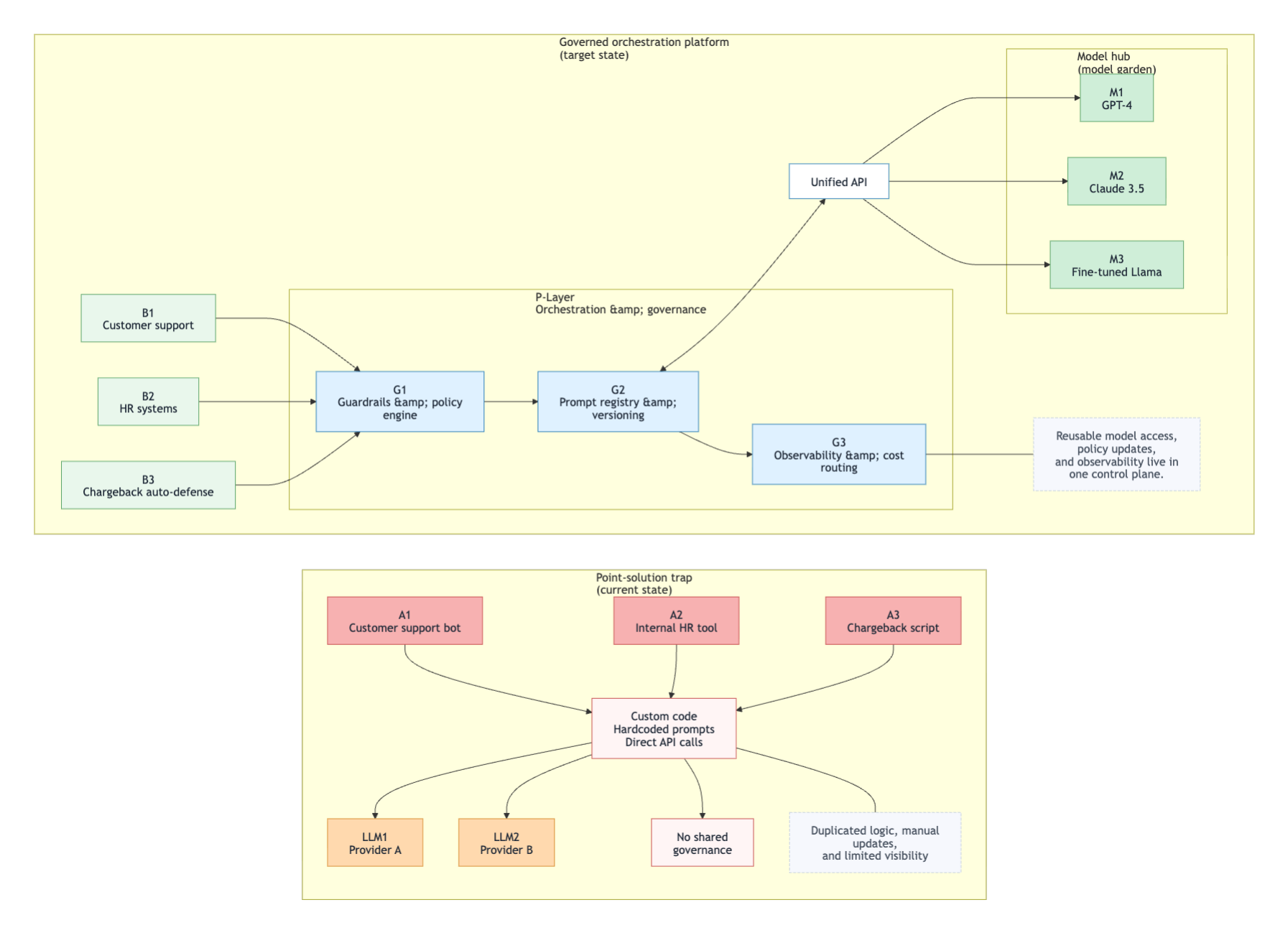
For structured, policy-driven inputs, these frictions turned architectural elegance on paper into operational drag in production. Figure 1 contrasts the point-solution trap with the governed target-state architecture, showing how shared prompt governance, observability, and model access replace duplicated logic and brittle direct integrations.
4. The Data-Driven Pivot: Prompt-First Generation
A structured review of system behavior led to a prompt-first redesign. Instead of retrieving additional examples from a vector layer, the system used carefully organized case inputs and modular prompt design to guide generation directly. This reduced system dependencies and made the workflow easier to observe, evaluate, and update.
Internal deployment measurements supported the shift. Generation latency decreased by 35%, internal quality scores increased by 20%, vector-store maintenance overhead was removed, and prompt changes could be applied immediately instead of waiting for re-indexing cycles. For chargeback summaries, where inputs are structured and policies change frequently, prompt-first generation outperformed the retrieval-heavy alternative in both efficiency and reliability.
The practical implication is not that RAG is broadly obsolete. Rather, the result suggests that retrieval should be matched to the information topology of the problem. When the task is decision-grade automation over structured inputs, simpler prompt orchestration can be the better engineering choice.
5. Engineering Trust: Control, Observability, and Auditable AI
Simplifying the architecture did not mean relaxing control. Trust had to be engineered into the system through modularity, traceability, and constrained execution. Two implementation patterns were especially important: prompt chaining and agentic orchestration.
Prompt chaining replaced large monolithic prompts with a sequence of smaller, purpose-built steps. Tasks such as evidence counting, title generation, and summary drafting were decomposed so that each step could be inspected, tuned, and validated independently. This reduced failure propagation and improved determinism.
Agentic orchestration then wrapped those steps in a controlled execution layer. Given a dispute identifier, the agent planned the workflow, invoked authorized data sources, coordinated prompt execution, and exposed step-level traces for review. Instead of behaving like a black box, the system produced auditable execution artifacts that could be examined during operations and review.
6. Governance as Data: Policy-Driven Guardrails
At enterprise scale, the central challenge is not simply generating fluent text. It is ensuring that every output is safe, policy-compliant, consistent, and measurable. To address this, the system incorporated a centralized evaluation layer, internally referred to as Cerberus, that ran multiple automated checks in parallel on every draft.
These checks covered several categories at once: sensitive-data detection, content policy moderation, schema and formatting validation, domain-specific rule enforcement, and readiness signals for downstream workflows such as translation or human review. Because the checks returned machine-readable evidence, the system could block, auto-correct, or reroute outputs before they reached an analyst. Figure 2 shows how the evaluation layer receives draft content and policy-as-data rules, applies parallel checks, and routes outputs to observability, model services, human review, or execution outcomes.
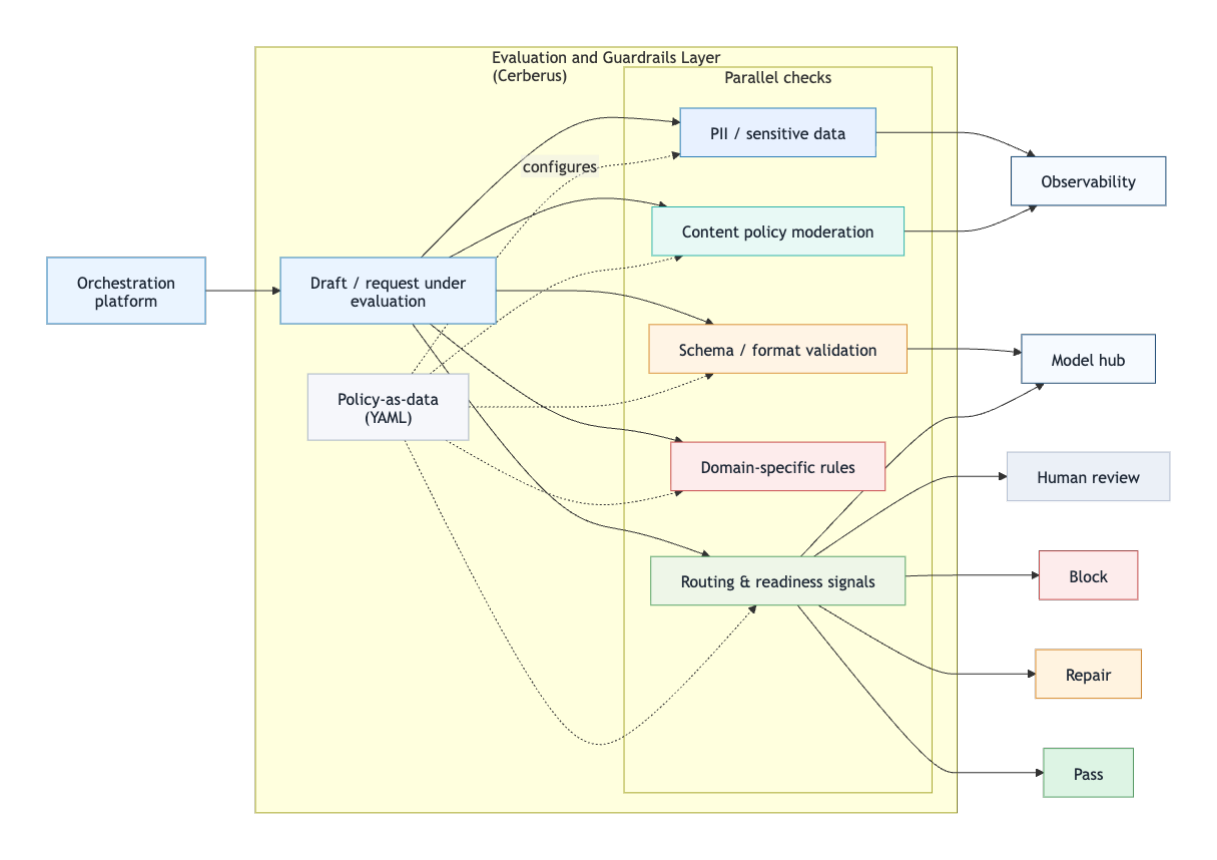
The framework auto-resolved 85% of policy issues before human review in internal deployment. Equally important, the guardrails were implemented as data - specifically YAML-configured thresholds and rules - so policy teams could update behavior without software redeployment. This design preserved flexibility while keeping governance explicit and testable.
7. Closing the Loop: Continuous Learning Through Human Review
No production AI system is flawless, so the architecture incorporated a Human Review and Feedback Loop (HRFL) to support continuous improvement. The purpose of the loop was not merely to catch errors, but to convert expert review into a measurable optimization signal.
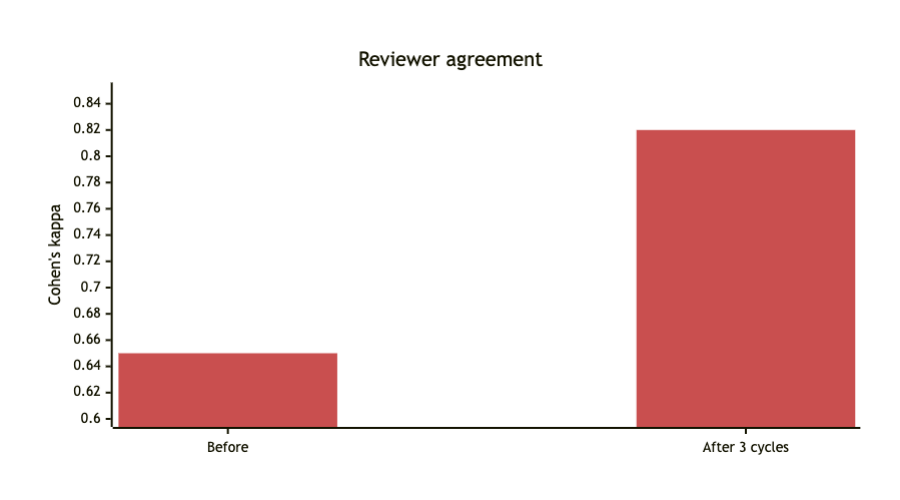
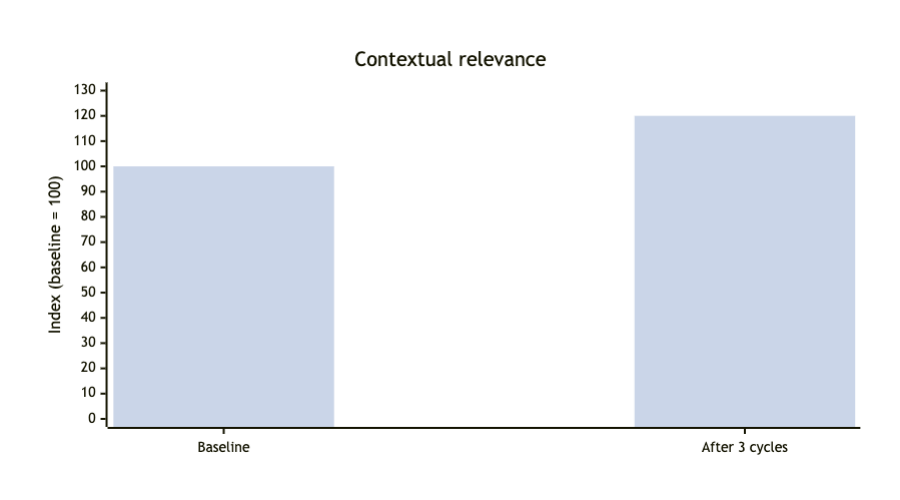
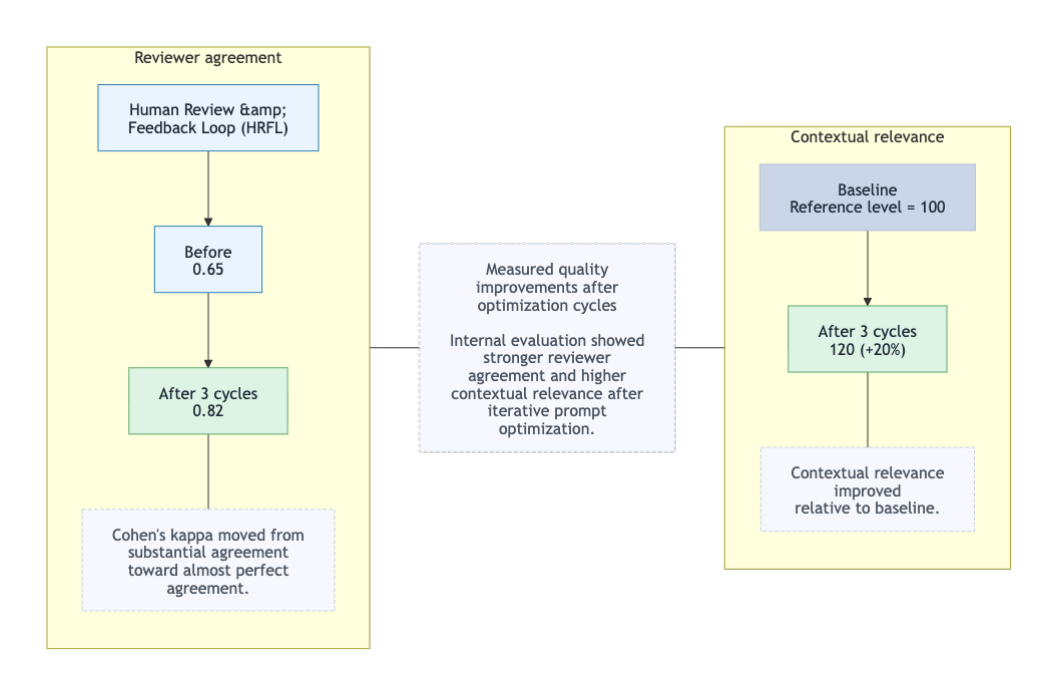
Reviewer consistency was monitored with Cohen's kappa, a widely used measure of inter-rater agreement for categorical judgments [5]. Across three optimization cycles, kappa increased from 0.65 to 0.82 in internal evaluation, while contextual relevance improved by 20%. The movement from substantial agreement toward almost perfect agreement supported the conclusion that reviewers found the system outputs increasingly reliable and aligned with operational expectations.
Figures 3 through 5 summarize the improvement trajectory across optimization cycles. Figures 3 and 4 isolate the gains in reviewer agreement and contextual relevance, while Figure 5 combines both outcomes into a single summary view of the HRFL impact.
The broader lesson is that production readiness is not achieved by a single model selection decision; it emerges from a repeatable loop of evaluation, feedback, and system refinement.
8. Final Takeaway: Match the Architecture to the Problem
The main conclusion of this case study is that AI architecture should be chosen as a response to workflow structure, not as an identity statement. Retrieval-centric systems remain useful for large, unstructured corpora and deep historical search. But for structured, policy-sensitive, latency-aware workflows, a prompt-first architecture can provide a better balance of speed, controllability, and operational fitness.
By shifting from brittle, retrieval-heavy integrations to a governed orchestration platform, the system described here made generative AI measurable, auditable, and adaptable in a decision-grade enterprise setting. In that sense, the most important design move was not adding more model complexity. It was building the surrounding architecture that allowed intelligence to operate safely at scale.
References
- Gartner. "Gartner Predicts 30% of Generative AI Projects Will Be Abandoned After Proof of Concept by End of 2025." Press release, July 29, 2024.
- MIT Project NANDA. The GenAI Divide: State of AI in Business 2025. July 2025. Referenced via public report summary.
- Sift. "The Rising Impact of Chargebacks and Consumer Disputes." Q4 2025 Digital Trust Index, citing Mastercard dispute projections.
- LexisNexis Risk Solutions. The True Cost of Fraud Study. 2025 North American merchant findings.
- Landis, J. Richard, and Gary G. Koch. "The Measurement of Observer Agreement for Categorical Data." Biometrics 33, no. 1 (1977): 159-174.